
We often think that when an organization runs into problems, whether with results or with culture, the issue lies in leadership, in the product or service it offers, or in any number of other things. But sometimes it's essential to first ask ourselves: is our organizational structure the right one to meet the business's objectives?
Are org charts still necessary?
With so much progress in technology and HR systems within organizations, every leader and employee can now access always-updated online directories with very complete information. But there's a certain value that only an org chart can provide: giving everyone an orderly, visual view of the information, and helping employees get a clearer picture of each role's place in the organization — something only an org chart can offer.
What you need to know
- 1. What is an organizational chart?
- An organizational chart is like a roadmap of a company, a graphic representation of its organizational structure and the people who make it up. The org chart shows the reporting path for every role and employee, as well as the relationships between different departments.
- 2. What is an org chart for?
- The purpose of an org chart is to offer a panoramic view of the organization, allowing every team member to identify their role within it and the reporting lines of each department.
- 3. What are the most common types of org charts?
- The main ones are the hierarchical org chart and the matrix org chart.
- 4. What benefits does an org chart offer?
- It improves visualization of the organizational structure, clarifies hierarchies and responsibilities, facilitates planning, and helps identify problems in the structure.
- 5. Who should have access to the org chart?
- Ideally, every member of the organization, to promote transparency and a shared understanding of the structure.
Who created the first recorded org chart?
The first recorded organizational chart is attributed to Daniel McCallum, an American railroad engineer and manager. In 1854, McCallum was named general manager of the newly formed New York and Erie Railroad. During his tenure, he implemented an organizational system that included a detailed org chart showing the company's hierarchical structure and the responsibilities of each department and employee.
Types of Organizational Charts
At Integratec, we've come across so many variations of org charts over the years that trying to name them all can feel overwhelming. But based on our experience, we've concluded that all of them derive from two basic types:
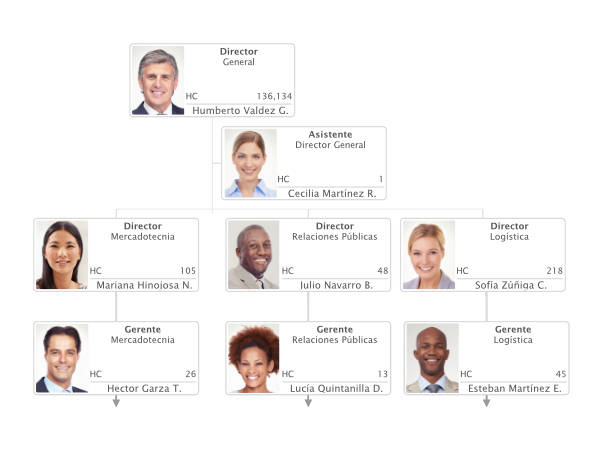
1. Hierarchical Org Chart
This is the most common type of org chart. In a hierarchical org chart, positions and roles are represented at different levels, from senior leadership down to the lower levels of the organization. It's typically shown as a pyramid, where the upper levels represent leadership and strategic decision-making, and the lower levels represent front-line employees and operational roles. Hierarchical org charts are easy to understand and help employees quickly grasp their role within the organization.
The hierarchical org chart is useful for understanding a company's organizational structure, identifying responsibilities and levels of authority, and visualizing how communication flows within the organization. It can also help employees understand their position within the structure and who they should report to.
2. Matrix Org Chart
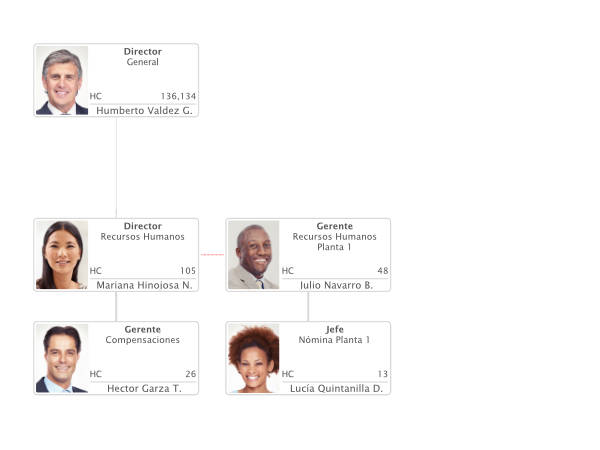
As organizations grow, reporting lines can become more complex. It's not unusual for a position to report to more than one supervisor.
In a matrix org chart, employees are organized along two main dimensions: a functional dimension and a project or product dimension. This means employees report to two supervisors: one in their specific function or department, and another for the project or product they're working on.
The purpose of the matrix org chart is to allow for greater flexibility and collaboration in environments where projects or products require input from multiple functional areas. It makes it easier to allocate resources and coordinate across departments by letting employees work on specific projects while keeping their functional reporting line.
Many variations can emerge from these two types of org chart, changing how they're drawn or adding more detail. But at its core, an org chart will always be based on one of these two models.
The benefits of using an org chart
The org chart often stays within the HR department, but its use can benefit the whole organization.
- 1. It's visually friendly.
- The org chart provides an easy way to visualize a company's full structure. Because it's graphic and easy to understand, it encourages everyone to use it to learn more about the organization.
- 2. Clear hierarchies and responsibilities.
- The org chart, being a representation of roles arranged hierarchically, gives a clear picture of who is responsible for each area and makes life easier for leaders.
- It's especially useful for new hires, helping them quickly orient themselves within the organization and get to know all of its areas.
- 3. It makes planning easier.
- Whether during growth or headcount adjustments, the org chart helps company leaders get a clear, accurate picture of the current situation, making it easier to identify key people within the organization.
- An important factor is the additional information an org chart can surface to users. If leaders can view organizational metrics right from the org chart, it makes planning processes far more productive.
- 4. It identifies structural problems.
- By comparing the organizational structure of different areas, if we combine the org chart with metrics like costs, sales, or other indicators, we can identify whether structure is playing a decisive role in the difference in results between two areas.
- While the org chart alone can't lead us to a conclusion, it does help us identify problems more clearly.
- 5. Cost savings.
- As organizations grow, it becomes difficult to keep the structure orderly, and positions that are no longer needed — or that would be more useful elsewhere — often stay put.
- The org chart helps identify these cases and supports better decision-making.
Who should have access to the org chart?
Access to a company's org chart is a relevant question that deserves careful consideration. In general, it's recommended that the org chart be available to every member of the organization, from the highest levels of the hierarchy down to the lowest. This allows for a better understanding of the organizational structure and fosters transparency in decision-making. Giving access to every employee also promotes a sense of belonging and collaboration, since each member of the organization can see their place in the bigger picture and understand how they relate to everyone else.
That said, there are certain exceptions and considerations to keep in mind when deciding who should have access to the org chart. In some cases, it may be necessary to restrict access to specific information, especially when it comes to sensitive or confidential details, such as salaries or the contact information of key people.
Authorized headcount vs. actual headcount
In the context of org charts, it's important to understand the difference between authorized headcount and actual headcount. Authorized headcount refers to the organizational structure that has been planned and officially approved by senior leadership. This structure usually reflects the hierarchy, roles, and responsibilities intended for each position within the organization. Authorized headcount is a theoretical, strategic representation of how the company is meant to be organized.
Actual headcount, on the other hand, refers to the organizational structure that currently exists within the company at a given moment. Actual headcount often differs from authorized headcount due to various factors, such as changes in the organization's needs, staff reassignments, or team growth or reduction. Actual headcount shows how the organizational structure has adapted in practice and reflects the real distribution of positions and responsibilities within the organization.
Is there a minimum headcount to need an org chart?
In general, an org chart becomes more useful as an organization grows in size and complexity. As headcount increases and more departments or functions are added, it becomes more important to establish a clear organizational structure to facilitate communication, coordination, and decision-making.
That said, it's worth noting that even small organizations with few employees can benefit from a simple org chart that provides a general overview of functions and reporting relationships. It helps define roles and responsibilities, avoids confusion, and lays the groundwork for future growth.
How does technology help build org charts?
Depending on the size of the organization, we can use platforms that make it easy to draw boxes and lines, which is especially useful for smaller organizations. When it comes to building a large org chart, it's very helpful to use tools that let you generate the org chart automatically from an Excel document.
Finally, it's key to look for a platform that makes it easy to keep the org chart up to date without having to constantly upload files — modern systems let you connect directly to databases or HR systems for this.